A significant piece of Shoshone heritage has returned to its rightful place in the mountains of northern Utah.
A large rock, carved with petroglyphs over a thousand years ago by the ancestors of the Northwestern Band of the Shoshone Nation, was recently repatriated after more than a decade of careful planning and collaboration.
The rock, weighing approximately 2,500 pounds (1,134 kilograms), had spent decades on display outside a church meetinghouse in Tremonton, roughly 80 miles (129 kilometers) north of Salt Lake City.
Its journey back to the rugged hillside near the Utah-Idaho border represents the culmination of a 14-year effort involving historians, conservators, state officials, and tribal leaders.
History of the Rock
View this post on Instagram
The origins of how the rock ended up at the church remain partly unclear. Accounts suggest that around 80 years ago, a group of individuals moved the heavy stone into a pickup truck and transported it to the town.
Ryan Saltzgiver, history sites curator for the Church History Department, noted that the placement was likely not malicious but stemmed from a lack of understanding of its cultural significance.
For decades, the rock remained outside the church, first near a flagpole and later on the building’s north side. Archival black-and-white photos show it on display, yet the rock’s spiritual and historical importance to the Shoshone Nation remained overlooked.
Repatriation Process
The initiative to return the rock began in 2011, when amateur archaeologists used a 1937 rock-art survey to trace its original location. The Utah State Historic Preservation Office helped coordinate the effort, while the Church of Jesus Christ of Latter-day Saints collaborated with the tribe to develop a detailed preservation and repatriation plan.
Conservators carefully removed the rock from its concrete base. Using saws, chisels, and gentle cleaning techniques with soap and water, they removed years of lichen growth without disturbing the ancient petroglyphs.
The rock was temporarily transported to Provo, where the Midwest Art Conservation Center applied precise methods, including bamboo and plastic tools, to maintain its original patina.
Return to the Mountains
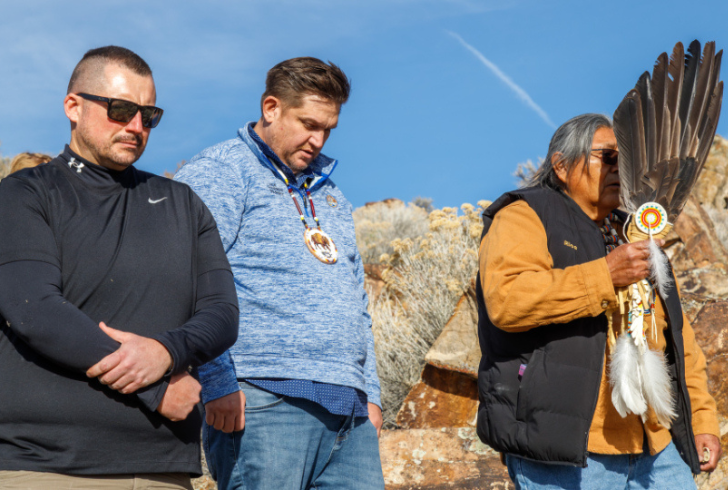
www.idahostatejournal.com | Shoshoni leader Rios Pacheco blessed the rock after its secret helicopter relocation.
After conservation, the rock was moved closer to its original site near the Utah-Idaho border. A helicopter was used to place it in a secure location, undisclosed to the public to ensure its protection. Tribal spiritual leader Rios Pacheco performed a blessing in Shoshoni, reaffirming the rock’s sacred significance.
Brad Parry, vice chair of the Northwestern Band of the Shoshone Nation, described the moment as deeply emotional. He emphasized the spiritual importance of the site, where ancestors once camped and hunted.
Parry likened the return of the rock to “putting a puzzle piece in place,” noting that restoring elements of Shoshone history is vital after generations of disruption.
Perspectives and Significance
David Bolingbroke, research and outreach historian for the Church History Department, highlighted that the rock’s placement at the chapel was due to a lack of understanding rather than intentional disrespect. Saltzgiver emphasized that the church views its role as both caretaker and responsible party for returning sacred items to their rightful owners.
The successful repatriation demonstrates a careful balance of historical research, conservation expertise, and collaboration with tribal leaders. It restores a tangible connection to Shoshone ancestry and strengthens cultural preservation in the region.
The return of this petroglyph-covered rock marks a meaningful restoration of Shoshone heritage in northern Utah. It now resides among other sacred rocks in its ancestral landscape, continuing to hold spiritual and historical significance.
As Brad Parry stated, “This rock was meant to be here. It’s like this rock knows it’s home.”
This repatriation serves as a reminder of the importance of respecting cultural artifacts and preserving the stories of the past for future generations.