

War often forces split-second choices that define a lifetime. On October 7, 1918, near the Meuse River in France, Cpl. Ralyn M. Hill made one of those choices. Under direct enemy fire, he crossed into hostile ground to rescue a fallen pilot.
For decades, the airman’s identity remained uncertain. Historical records now point to 2nd Lt. Wellford MacFadden Jr., closing a mystery that lingered since World War I.
This account traces Hill’s service, the battle conditions he faced, and the investigation that identified the airman he carried from German lines.
Early Life and Military Service
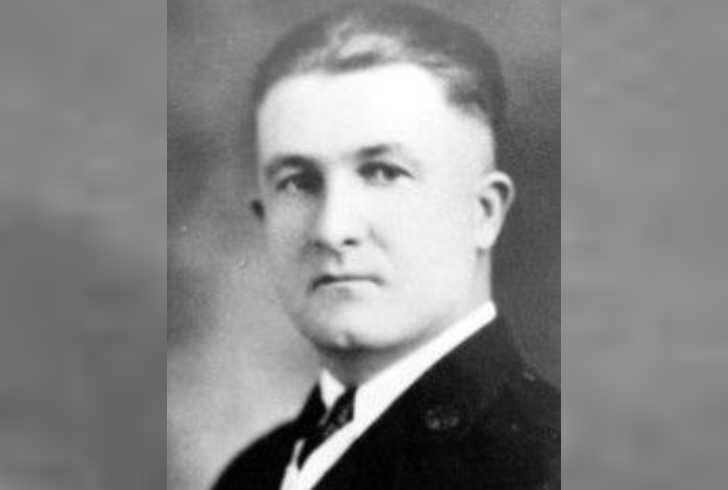
findagrave.com | Born in Lindenwood, Ralyn M. Hill joined the 33rd Division in 1917 for service in France.
Ralyn M. Hill was born on May 6, 1899, in Lindenwood, Illinois. When the United States declared war on Germany on April 6, 1917, he enlisted in the Illinois National Guard. After completing training, he deployed to France with Company H, 129th Infantry Regiment, 33rd “Prairie” Division.
Once overseas, the 33rd Division temporarily separated. Although Gen. John J. Pershing wanted the American Expeditionary Forces to fight as a unified body, Lt. Gen. John Monash persuaded American and British leaders to attach U.S. units to his Australian Corps for an assault at Hamel, Somme.
As a result, elements of the 33rd Division entered combat alongside Australian forces on July 4, 1918. The date was intentional. The attack succeeded quickly and highlighted Monash’s coordinated use of infantry, artillery, tanks, and aircraft. It also began a lasting partnership between American and Australian troops.
Combat Operations
After Hamel, the 131st Infantry fought with distinction at Chipilly Ridge and Amiens on August 9. Soon after, on August 23, the 33rd Division reassembled and moved to the Toul sector, honoring Pershing’s earlier intent to consolidate American units.
Within the division, the 65th Infantry Brigade formed around:
129th Infantry Regiment
130th Infantry Regiment
124th Machine Gun Battalion
The unit then joined the St. Mihiel offensive, which concluded successfully on September 18, 1918. Days later, on September 26, American forces launched a major push into the Argonne Forest. There, they confronted the German Fifth Army across dense woods and fortified positions near the Meuse River.
The campaign lasted six weeks. German defenses inflicted heavy losses on advancing American divisions. Conditions were harsh, visibility was limited, and artillery fire was constant.
The Rescue at Dannevoux Hill
On October 7, 1918, the 129th Infantry fought near Dannevoux Hill. By then, Hill had earned the rank of corporal. While observing the battlefield, he witnessed a biplane spiral out of control and crash on the enemy side of the Meuse.
The aircraft appeared French-built. The pilot lay wounded behind German lines.
Hill’s Medal of Honor citation reads:
“Seeing a French biplane fall out of control on the enemy side of the Meuse with its pilot injured, Cpl. Hill voluntarily dashed across the footbridge to the side of the wounded man and, taking him on his back, started back to his lines. During the entire exploit he was subjected to murderous fire of enemy machine guns and artillery, but he successfully accomplished his mission and brought his man to a place of safety, a distance of several hundred yards.”
Despite sustained machine-gun and artillery fire, Hill carried the pilot several hundred yards to safety. On April 22, 1919, in Ettelbruck, Luxembourg, Gen. Pershing presented Hill with the Medal of Honor.
Who Was the Pilot?
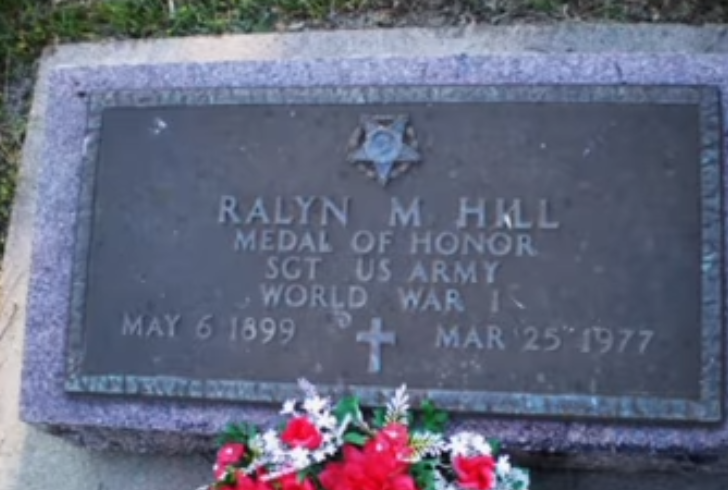
YouTube | PRESIDENTIAL HISTORIAN | Ralyn M. Hill died on March 25, 1977, and is interred in Abilene, Kansas.
Although Hill’s heroism was never questioned, records raised doubts about the airman’s nationality. French records for October 7 listed no aircraft losses. The biplane, however, had been manufactured in France.
That same morning, the 103rd Aero Squadron of the U.S. Army Air Service reported losing contact with a French-built SPAD XIII fighter. The aircraft was last seen around 11 a.m. and officially declared “missing in action” by 12:30 p.m.
The missing pilot was 2nd Lt. Wellford MacFadden Jr..
MacFadden was later identified and buried two miles west of Brieulles, opposite the 4th Division’s sector. His grave was rediscovered by Capt. Friedrich Wilhelm Zinn, a former observer in French escadrille Sop.24. Zinn later became known for documenting U.S. Army Air Service losses under the principle “leave no man behind.”
Evidence suggests that MacFadden likely fell to German ground fire, as no German fighter units claimed an aerial victory that day. His aircraft probably crashed within German lines. Hill’s rescue attempt appears to match the timeline and location of MacFadden’s disappearance.
MacFadden died shortly after the rescue due to his injuries. His death does not diminish Hill’s actions. The effort to recover him, alive or not, reflects the battlefield ethic that no fallen service member should be left behind.
Life After the War
After World War I, Hill built a career in law enforcement. He served as a sergeant deputy sheriff in Oregon, Illinois, and later as a police officer in Abilene, Kansas.
He married Iva Fern Rock and had three daughters: Pauline Murphy, Shirley J. Patterson and Mary Ellen Reynolds.
Ralyn M. Hill died on March 25, 1977. He was buried in Abilene, Kansas.
Cpl. Ralyn M. Hill’s actions on October 7, 1918, stand as a clear example of courage under fire. His decision to cross into enemy territory to retrieve a wounded pilot led to the nation’s highest military honor. For years, the identity of that pilot remained uncertain. Historical records now align with the loss of 2nd Lt. Wellford MacFadden Jr., giving the story a name and a face.
The rescue at Dannevoux Hill connects two American servicemen—one who carried, and one who fell—through a moment of shared sacrifice. More than a century later, the record reflects both the bravery of the rescuer and the service of the airman whose identity was finally confirmed.